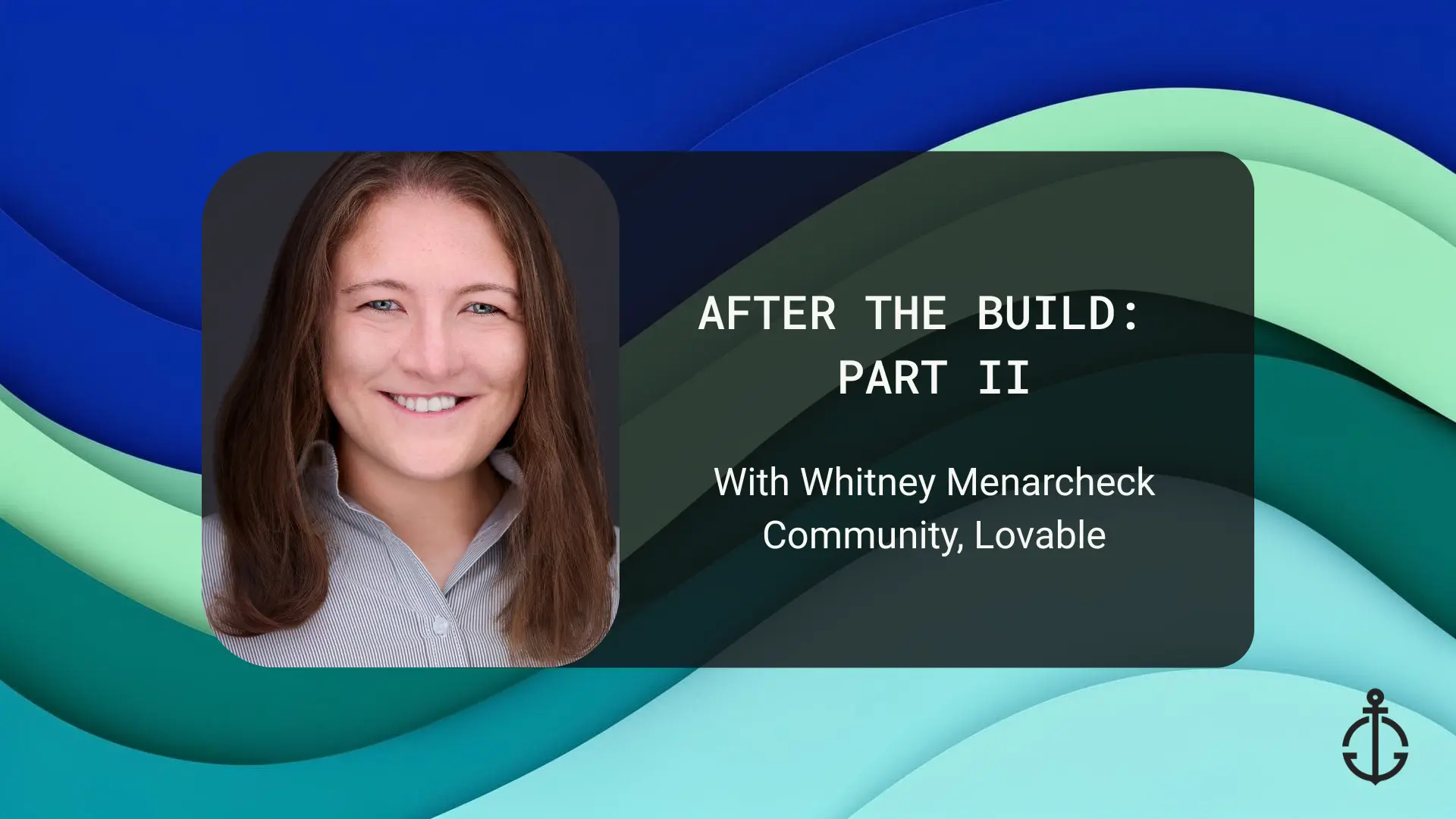
This conversation is about why momentum breaks after the build, even when the strategy is right.
Whitney helped me understand that momentum is emotional before it's operational. People keep going when they feel seen, trusted, and connected to others they identify with. Not when they are managed, optimized, or impressed.
We talked about what's most helpful when SheBuilds alumni want to give back, why honest builder stories matter more than polished hype, how Whitney navigated the early days of Discord by starting with relationships instead of rules, and why community cannot be heavily structured by the company without losing trust.
If Elena Verna's advice was about how to place better bets, Whitney's was about the emotional conditions required to follow through on them long enough for those bets to work.
Community is infrastructure
As someone who has helped oversee and shape communities across multiple roles, I've learned that ecosystem is not a growth channel. It's infrastructure. When it works, momentum compounds. When it doesn't, even the best strategy stalls.
After building alongside the SheBuilds on Lovable community and experiencing firsthand how much intentional care goes into making that momentum feel sustainable, I wanted to understand how it actually works behind the scenes. That curiosity led me to sit down with Whitney Menarcheck to talk about trust, belonging, and what keeps people building long after the initial excitement fades.
Despite being a long-time fan of Elena Verna's work, after my conversation with her I felt unusually centered. Not because I had everything figured out, but because I had a framework: optionality, short test cycles, and pressure-testing reality instead of narrating it.
What I didn't yet understand was why some people actually follow through in that window, while others stall out, even when the strategy is sound. That's the layer Whitney helped me finally see.
This post is part of a three-part series exploring what actually comes after a build. The moment when momentum can compound or fade. Each conversation looks at a different layer of that moment, from decision-making to emotional momentum to operator execution.
Whitney leads the Discord and SheBuilds community at Lovable. Our conversation wasn't about tactics or growth hacks. It was about the human infrastructure underneath momentum. The conditions that make people keep building after the adrenaline fades. The difference between a community that looks active and one that actually changes how people move through uncertainty.
This post is about what she's learned by walking into a messy, imperfect community and helping it work without over-structuring it into something brittle.
If you're building community, leading ecosystem marketing, or trying to be a thoughtful connector after a moment of visibility, this is a practical look at what actually holds momentum together.
Community isn't a channel. It's a condition.
A clear strategy can still stall if people don't feel safe enough, seen enough, or connected enough to keep going.
Momentum doesn't collapse because the plan was wrong. It collapses when the emotional load becomes too heavy to carry alone.
Whitney doesn't talk about community as a growth lever. She talks about it as an environment. One where people feel safe enough to try, seen enough to keep going, and connected enough to take the next step without needing a perfect plan.
One sentence she shared anchored the entire conversation for me:
My job is to deliver all the resources and support and get out of the way. Because people will rise up and do amazing things. They just need the opportunity.
That line contains an entire operating system. It's also a useful gut check for anyone building a community, running an ecosystem motion, or acting as a connector.
Are you creating the conditions for others to rise? Or are you unconsciously trying to remain the center of gravity?
How Whitney actually came into community leadership
Whitney didn't enter Lovable with a polished community playbook. She came in sideways.
She was originally a Lovable customer, working in behavioral health and trying to build a product of her own. When funding dynamics in that space shifted, she noticed a "we're hiring" line buried in Lovable's console logs.
She applied for a part-time support role. That turned into a full-time role. Then she was pulled into the community. Seven months later, she was leading Lovable's Discord and SheBuilds programming. That detail matters.
She didn't come in trying to impose a system. She came in trying to understand what people were already protecting. If you've ever spent time in the Lovable community, this posture is unmistakable, and it explains a lot about why it works.
Diving into Discord
One of Whitney's first major responsibilities was owning Lovable's Discord. When she stepped in, it wasn't pristine. Given their growth trajectory, that's not surprising.
What's interesting is what she didn't do next.
She didn't start with rules, tooling, or enforcement. She started with relationships.
My entry into community management was based on building relationships with the community leaders. Finding what they value, what brings them to life, and then supporting it.
Practically, that meant spending time with the people who already cared. Paying attention to what energized them. Removing friction for the work they were already doing. Resourcing them so they could lead.
Only then did structure emerge.
People often ask how to scale a community. This is the unglamorous answer: You scale it by understanding who already feels ownership and then letting them cook.
How SheBuilds alumni can pay it forward
I asked Whitney where alumni and builders are most helpful as Lovable and SheBuilds grow.
Her answer wasn't about promotion. It was about visibility that creates identification.
We've made a conscious decision that we're all about the builders. It's the age of the builder.
Lovable actively wants alumni to build in public, visibly and unapologetically.
"Don't think you're being self-promotional. The further you get, the further you'll be able to help other people get."
The mechanism is simple but powerful.
"It defeats the internal talk. Who do I identify with?"
When people see someone like them try, they try too. With tools like Lovable acting as a great equalizer, sharing becomes a form of care, especially in an AI-shaped world where people can be left behind quickly.
The content she can do without
Whitney was equally clear about what she prefers not to amplify. Not content optimized for spectacle over signal. (We've all seen the "look what you can build in 30 seconds and make a million dollars" comment for the secret plan offers.)
She resonates more with honest, imperfect stories that reflect the emotional reality of the work.
She told me about a Season 01 SheBuilds participant who posted a photo of herself passed out on the couch after the 48-hour build (I can definitely relate). Whitney's reaction was immediate. "That's amazing. That's real."
If you're growing an ecosystem, this is a useful rule. The content that builds trust is often the opposite of the content optimized for polish.
The spirit of keeping community community-led
Whitney drew a boundary many companies agree with intellectually but sometimes violate operationally.
I can't see a community being successful when it's so heavily structured and managed by the entity. It truly needs to be community-led.
She tied that directly to leadership mindset.
"Our community wouldn't be successful if it wasn't for our founders and what they value."
If leadership wants community outcomes but can't tolerate autonomy, trust never compounds.
Trust scales emotionally, not rationally
Whitney came back to emotion repeatedly, including when talking about product bugs.
You'll put up with the bugs when you feel like they actually care.
That applies just as much to community as it does to product.
People forgive imperfection when they trust intent. They disengage when they feel dismissed, even if everything technically works.
Belonging isn't a nice-to-have. It's the foundation.
The future of community is proximity, not influence
When I asked what matters more in the next few years, Whitney didn't mention platforms. She mentioned closeness.
It's not 'that influencer' or 'that athlete.' It's 'that mom next door' or 'that fellow student.'
SheBuilds works because women see themselves in other women and hear the same internal doubts reflected back.
Ecosystems don't grow because they look impressive. They grow because they feel reachable.
Reframing "difficult" community members
Having helped oversee and shape communities across multiple platforms in past roles, and seeing how consistently positive and supportive the Lovable community remains despite its rapid growth, I asked Whitney how she thinks about community members who might be mislabeled as "difficult."
Her answer was both grounded and generous.
She cautioned against jumping to conclusions too quickly. What can initially come across as dismissive, sharp, or disruptive often turns out to be something else entirely: deep passion, strong conviction, or frustration rooted in care.
I have to hold that and look beyond what's coming at me on the surface.
That posture matters. This isn't about tolerating harmful behavior or ignoring boundaries. It's about signal detection.
Community leaders who assume good intent first are better equipped to distinguish between misalignment and imperfect expression from someone who deeply cares.
The reminder here is subtle but important: if you react only to tone, you may miss commitment. And if you misread commitment as hostility, you risk pushing out the very people who care the most.
In fast-growing communities, that discernment becomes a leadership skill, not a soft one.
How to be a connector without becoming extractive
Whitney shared a simple ethics framework for stewarding a growing network.
- First, self-awareness: If you lack it, you can't be authentic.
- Second, act before you ask: She takes action for others long before requesting anything in return.
- Third, demonstrate that you truly see the person: Not as a name or a LinkedIn profile, but as a human.
That's what builds trust.
What she told me to do next
Whitney's guidance after SheBuilds was concrete.
Start with women's groups and relevant associations that serve the audience of the product you built. Choose the mediums they already use. Make content for them. Use the visibility of the win to pull others up.
She also made it explicit that Lovable wants SheBuilds alumni to take up space.
"Tag us. Use our names. It's okay. This is the time for you to own it."
The principle I'm taking with me
Momentum is emotional before it's operational.
Strategy helps you place bets. Community helps you stay in the game long enough for those bets to pan out.
The best community builders don't manage people. They create the conditions for people to rise, then get out of the way.
The compass I'm using:
- Belonging over control
- Proximity over influence
- Contribution over leverage
- Trust as the product
I haven't found a better filter yet. When people feel seen, they take smarter risks and stay in the game longer. That's momentum.
Where to find Whitney Menarcheck
Whitney regularly shares grounded, practical thinking on building trust, stewarding community at scale, and creating conditions where people actually show up for each other.
- LinkedIn: Where she shares practical thinking on community leadership
- Newsletter: Her deeper dives on community, building, and belonging
- Website: Her personal site built with Lovable
- Lovable Community: Connect with builders
- Lovable Discord: Join the community she helps steward
- SheBuilds on Lovable: Buildathon on March 8, 2026
Built With
(Building in Public)About
Anchor GTM Anchor GTM is a space for first-hand operator insight from the messy middle of building, shipping, and deciding what comes next. No playbooks. No hot takes. Just pattern recognition from people close to the work.
More from the series
Optionality Isn't a Luxury. It's a Strategy.
After a build, you might find yourself asking "what now?" once the ship dust settles. In this conversation, Elena Verna shares how to think about optionality as a strategy when figuring out where to place your bets and why the best next step is often the one that keeps the most doors open.
What Operators Do After a Big Ship
After a build, momentum creates opportunity and pressure at the same time. In this conversation, Lovable Ambassador and SheBuilds Season 01 winner Kat Hill Contag shares how operators decide what's next and turn a ship into leverage without rushing to scale.
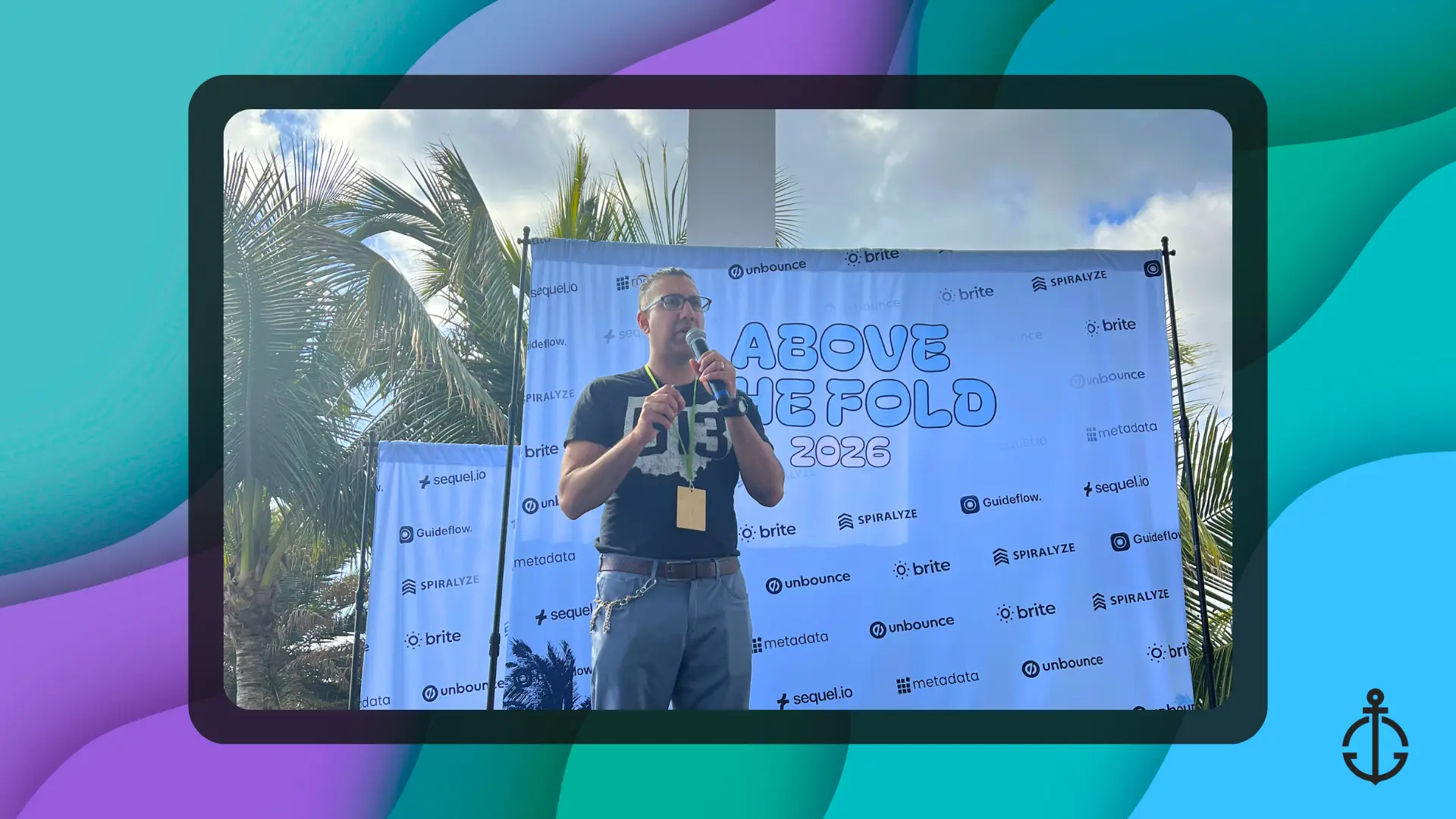
What Above the Fold Reinforced About Cognitive Load, Community, and AI-Era Moats
Above the Fold wasn't a conference. It was a room full of operators working at the height of their craft. From pricing psychology to homepage positioning to AI orchestration, the throughline was the same: reduce cognitive load, earn trust, and let clarity compound.