
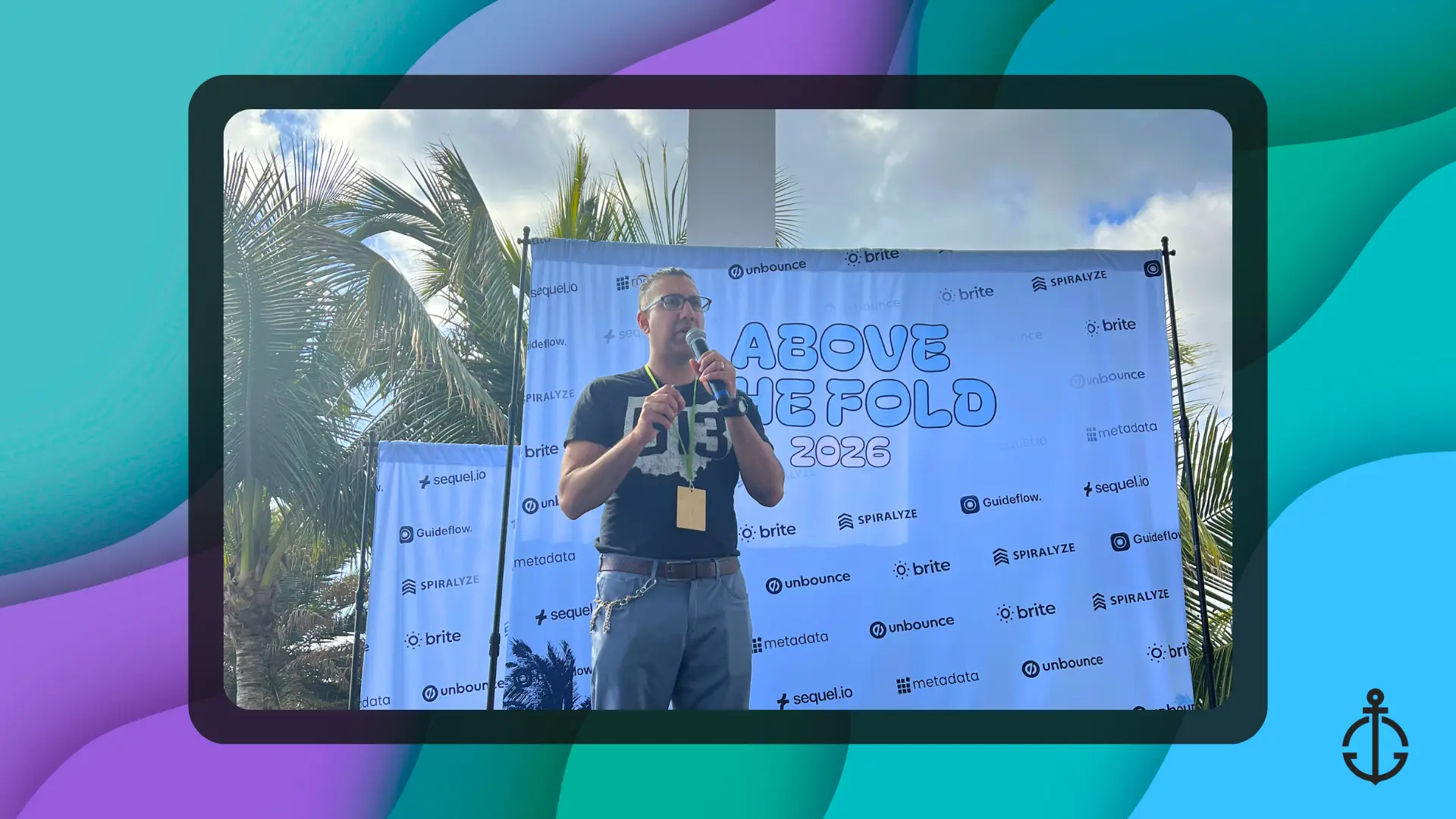
Above the Fold gathered ~70 senior marketers for workshops and real-time teardowns on pricing, positioning, demos, and AI agents. The throughline across every session was cognitive load: the companies that win next will deliberately remove friction versus adding more.
Pricing isn't arithmetic, it's behavioral design. Homepages aren't storage units, they're filters. Interactive demos don't reduce pipeline, they qualify it. And AI agents don't replace judgment — they expose whether you had it in the first place.
In today's AI-fueled market distribution compresses and content becomes abundant, the durable moat isn't features or automation. It's trust density that's compounded faster in curated rooms than in feeds. Community and IRL connection become primary growth levers, not side projects.
I hadn't been in a room like that in years. It wasn't a cavernous convention center, badge-scanning circus, or a panel lineup dripping in acronym-heavy platitudes.
Above the Fold was different. On the beach with a relaxed atmosphere, often open-air content, with ~70 senior marketers. Fractionals. Boutique agency founders. In-house operators carrying real revenue numbers. Workshops instead of keynotes. Real-time teardowns instead of theoretical frameworks.
You could feel it immediately. People weren't posturing. They were operating. And in a marketer-on-marketer crime, I'm almost embarrassed to admit I half-expected overly polished strategists and snake oil salesmen.
Instead, I watched deeply specialized experts work at the height of their craft, and saw diversity, building (including flailing and failing) in public, and authenticity. A Hollywood-trained videographer for industrial B2B. Niched vertical SaaS PMMs. And Rob Kaminski thinking through positioning in real time — lightning-fast, but not theatrical. Pattern recognition firing on all cylinders from hard-earned reps. It's compelling to watch someone truly inside their zone of genius.
There was a moment on Day 2, in a conversation with a new friend who had recently made the shift from marketing operator to a16z-backed CEO (and 'us' as their now ICP), where we were talking about Stellan Skarsgård's recent Oscar-nominated performance on- and off-screen. What makes him magnetic isn't noise. It's mastery. You believe him because he's fully inhabiting his craft and that confidence gives him undeniable swagger.
That's what the event felt like. And as the sessions unfolded — pricing psychology, homepage positioning, interactive demos, AI agent orchestration — something clicked.
None of it was really about conversion rates. It was about cognitive load. The companies that win next won't be the ones who add more — they'll be the ones who remove friction deliberately.
When AI dominates the market producing new shiny things faster than ever before and attention is scarce, time-to-value is measured in seconds, not minutes. If you don't collapse complexity immediately, someone else will.
Pricing Isn't Arithmetic. It's Behavioral Design
Most pricing pages assume buyers are patient analysts.
Toggle monthly vs annual. Interpret percentages. Compare five similar plans. Scan feature grids that feel like spreadsheets.
But people don't want to calculate. They want to sort.
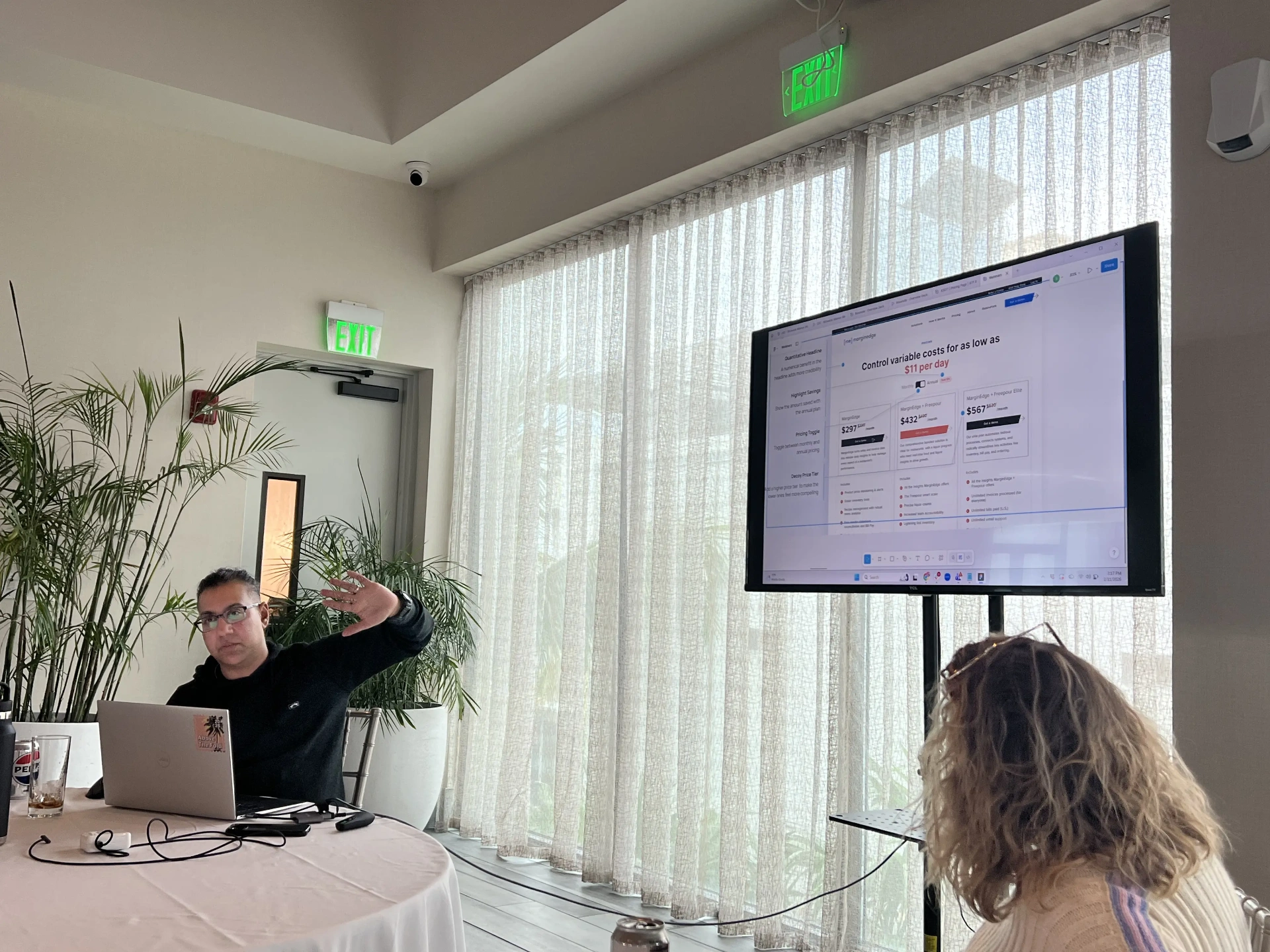
Sahil Patel framed pricing pages as a card-sorting exercise. Your buyer just wants to know which package fits them. Subtraction beats addition.
The strongest pricing pages we dissected felt disciplined rather than clever. Three or four plans max. Clear "best for" qualifiers. A decoy tier sized intentionally to anchor gravity without screaming. Social proof above the fold, feature detail below. Calculators used carefully — helpful for consumption-based pricing, but never allowed to hijack narrative.
And one deceptively simple reminder: don't make people do mental math.
If annual is 10% cheaper, toggle it and spell it out. Don't ask someone to calculate savings while deciding whether to trust you.
The more cognitive load introduced, the more friction created. Friction rarely announces itself. It shows up as delay. And delay is expensive.
We talked about indexed pricing. SEO eyebrows. Making the primary keyword the H1 and testing subheads underneath it. Owning your pricing narrative rather than letting comparison sites define it.
Jess Cook added another layer that hit harder than it sounds:
"If you can make a meme for your ICP and it lands, you truly understand them."
In an AI world where anyone can generate content, empathy becomes differentiator. If you can't joke about your buyer's lived experience in a way that resonates, you probably don't understand their pain deeply enough to design for it — pricing included.
Pricing isn't a grid. It's empathy expressed in structure.
Above the Fold Is a Filter, Not a Storage Unit
Homepage debates often get stuck in copy tweaks and CTA colors.
The deeper issue is shelf clarity.
If B2B SaaS were a physical store, Rob Kaminski challenged us to answer what shelf are you on? Who's next to you? What other products or status quo are you replacing? Why are you the best in the world for that replacement?
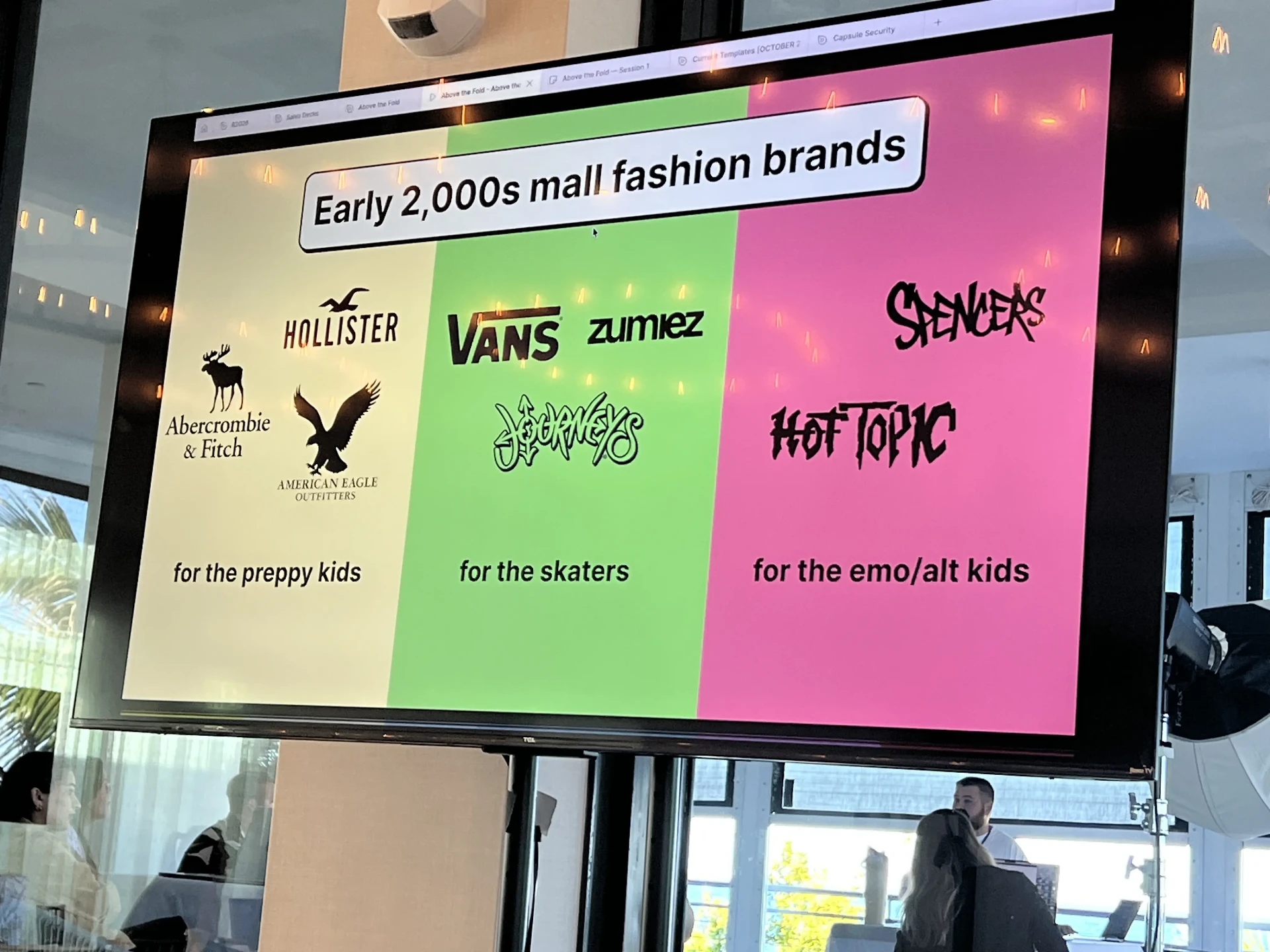
Positioning = description + differentiation
When you invent a category and compete against no one, no one shops for you. Sharp positioning compares against competitors buyers already understand.
If someone lands on your site and can't quickly answer what category you're in and why you're different, they begin working harder than they should.
And when buyers have to work, they stall.
One reminder repeated across sessions: if you have multiple products, don't summarize them all above the fold. Bet on one. Comprehensive often reads as confused. Sharp positioning feels exclusionary at first. It is. That's the point.
One reminder that felt like a departure from the last few years: landing pages still need navigation. According to Tas Bober, fully removing nav may spike short-term conversion, but Google will throttle you down. Minimal navigation is fine. Zero navigation isn't. Education and discoverability still matter.
Tas also reframed landing pages more broadly: most are built for conversion. But conversion is only one of four types of landing pages. Many should be built for education.
When in doubt, ask: Is this helpful?
We talked about speed. If your time to first byte is slow, the rest is academic. Clarity doesn't matter if the page won't load. And once it does, don't make them work for it.
Clarity narrows. Ambiguity sprawls.
"Specific is terrific," as my fifth-grade English teacher Carol Howard would say
And clarity before scale isn't just poetic. It's strategic.
Interactive Demos Compress Belief
For years, demos have been treated as gated sales artifacts — something unlocked after a form fill.
But Eric Holland made the case clearly: embedding interactive demos across the site changes the dynamic entirely.
- In the hero.
- On product pages.
- In the navigation.
- Inside blogs.
- Even in ads.
A well-constructed demo — roughly a dozen steps, half narrative, half function — allows someone to see themselves inside the product without risk. Most demos over-index on features and under-invest in story. The result reads like documentation. Only go deeper for specific audiences or use cases separately after you tackle that.
The better ones reduce belief friction — letting someone experience time-to-value before a sales call ever happens.
There's understandable tension from sales teams who fear cannibalization. But teams experimenting thoughtfully are seeing something different: interactive demos don't reduce pipeline. They qualify it. They accelerate it. They shorten the distance between curiosity and conviction.
Velocity is defensibility. And don't be afraid to show your brand's personality and sell some sizzle with that steak, versus simply tell.
AI Agents Expose Strategy
The AI sessions were the most complex — and the most revealing.
Anyone can spin up agents now. The tooling landscape is exploding — Make, n8n, Zapier, Clay, Relevance AI, manager agents coordinating sub-agents. But orchestration is still messy. Visibility across channels is fragmented. You can automate touches without truly understanding how an account progresses across email, ads, outbound, demo engagement, and product signals.
Without shared definitions and clean data, automation amplifies noise.
Alina Vandenberghe spoke candidly about this complexity. The moat isn't sending more automated emails. It's stitching humans and agents into a coherent system.
Automate one or two operational tasks. Free time for deeper thinking. But don't confuse volume for coherence.
Agents don't replace judgment. They expose it — and amplify your superpower.
And something revealing happened in the room. When asked to rate confidence working with agents, several men rated themselves highly without much hands-on experience. Several women with more practical experience rated themselves conservatively — myself included.
Confidence and competence don't always correlate.
Disciplined experimentation will separate signal from hype.
And again, the pattern held: reduce complexity until you can see clearly.
What I'm Changing Immediately
If you don't care about the theory and just want the practical shifts, here's what stuck:
Pricing
- Keep it to 3-4 plans max.
- Use "best for" qualifiers instead of pushing the most expensive tier.
- Size the decoy intentionally to drive gravity.
- Move detailed feature comparisons below the fold.
- Spell out savings; eliminate mental math.
- Use calculators thoughtfully; don't let them dominate narrative.
- Place strong social proof above the fold.
Homepage
- Clarify shelf + differentiation immediately.
- Compare against competitors buyers already understand.
- Bet on one primary product or wedge.
- Make your primary keyword the H1 for SEO (even styled as an eyebrow).
- Test subheads deliberately.
- Get load time under one second.
Interactive Demos
- Embed demos in the hero, nav, product pages, and blogs.
- Structure them 50% story, 50% function.
- Aim for 10-15 steps.
- Test "Explore Product" vs "Book a Demo."
- Use GIFs or screen recordings when full demos aren't feasible.
Trust Density
- Lead with proof.
- Move testimonials higher.
- Show, don't tell.
AI Agents
- Automate 1-2 operational pieces first.
- Ensure shared definitions and clean data.
- Track account progression across channels, not just touches.
- Keep humans in the loop.
- Disclose AI use transparently.
None of these are revolutionary alone.
Together, they form a pattern.
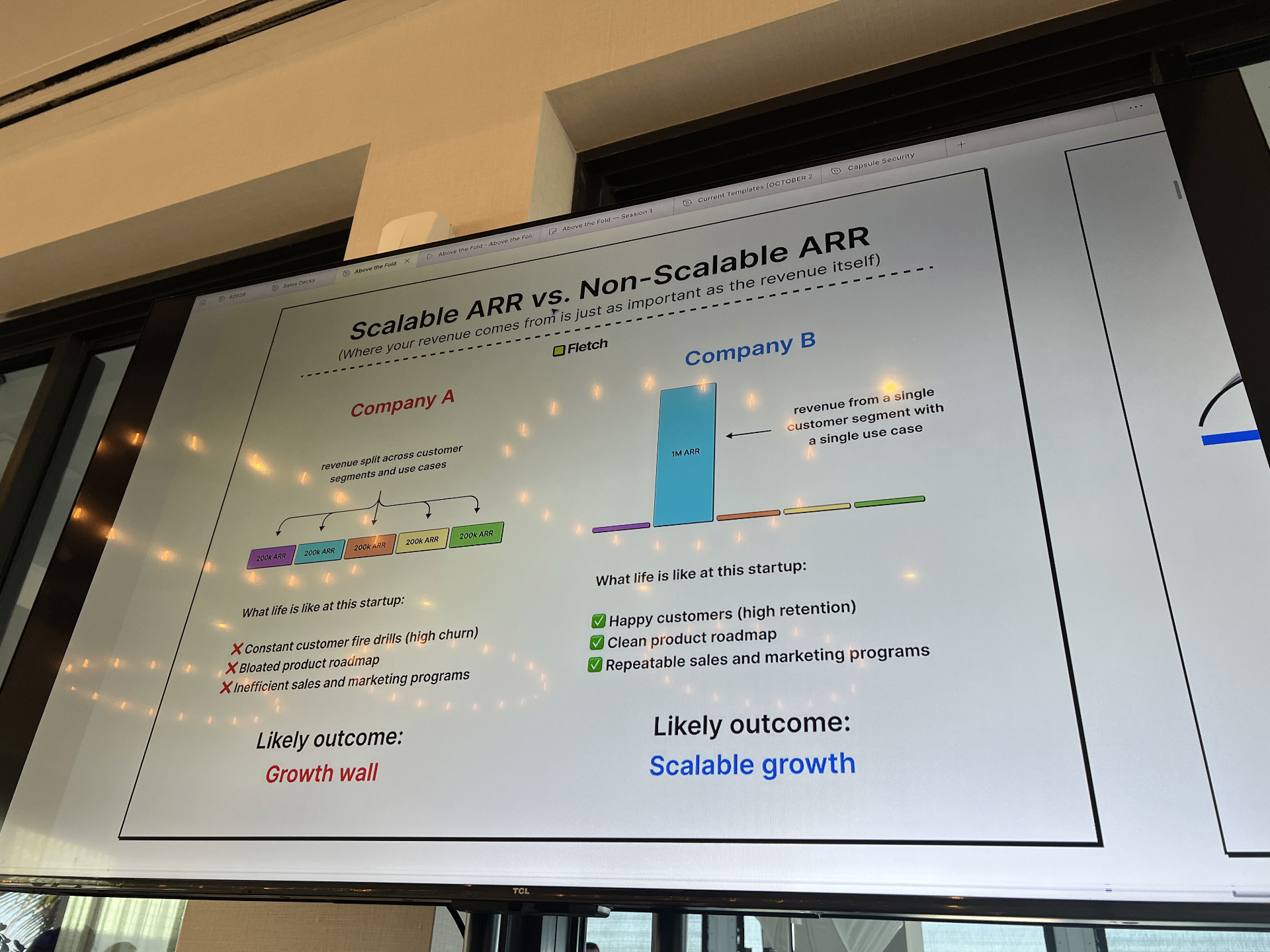
The Pattern Is Trust Density
Above the Fold reinforced something I've been betting on:
In today's AI-colored B2B SaaS world, community and IRL rooms become durable moats
AI compresses distribution. Content becomes abundant. Automation scales cheaply. Trust becomes scarce. And scarcity creates value.
Trust compounds fastest in rooms. Not massive expos. Boutique gatherings. Hands-on workshops. Real operator conversations.
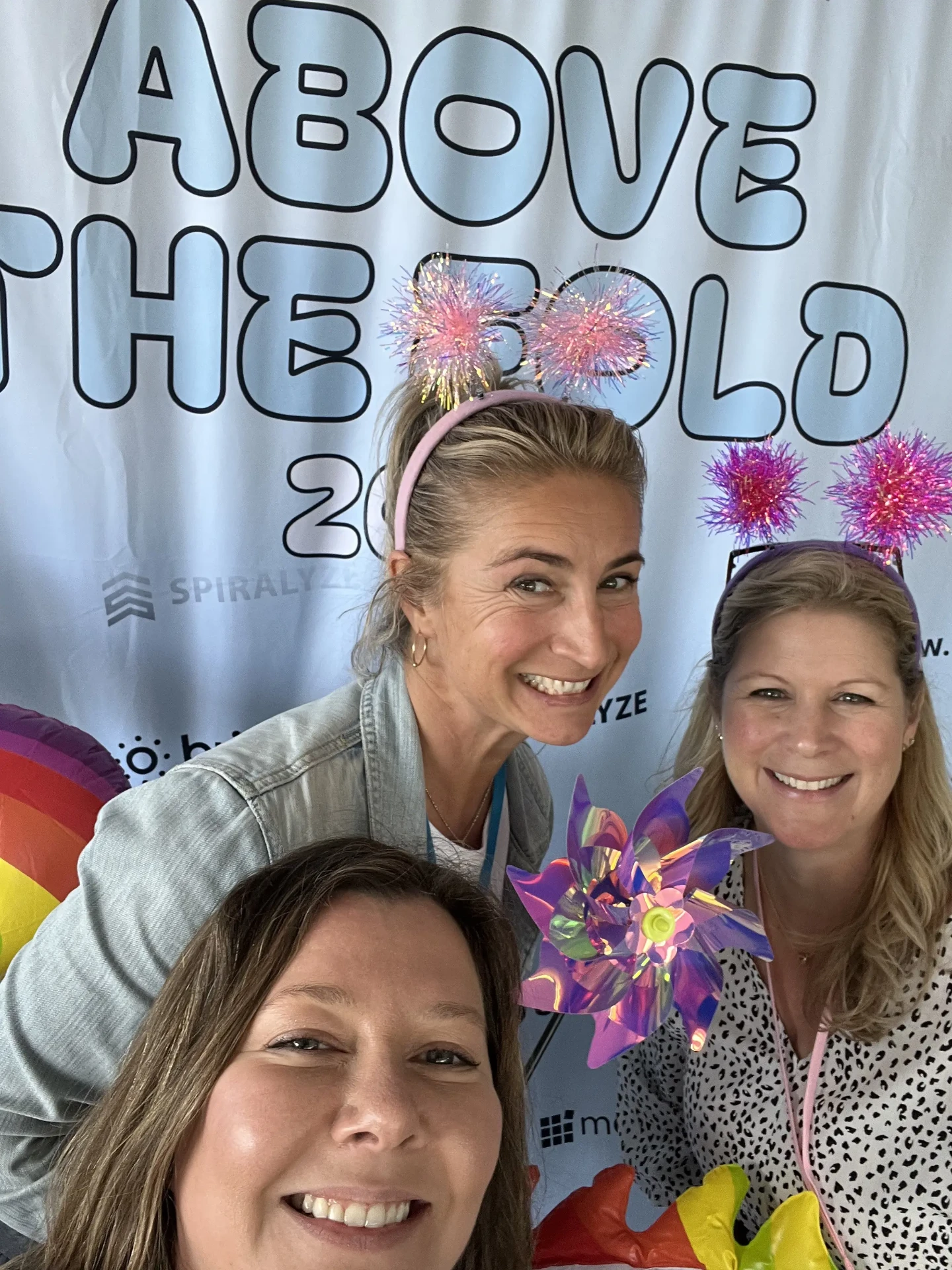
I hadn't attended an in-person marketing event since HubSpot's Inbound years ago. I didn't realize how much I missed being in a room where people are fully inside their craft — and generous about it.
Smaller gatherings — curated, operator-dense, signal-rich — are hard to replicate. The 'forced fun' networking sessions were actually useful. The mix of fractionals and in-house operators created cross-pollination. The intimacy allowed real vulnerability. Even the event design choices — scale, format, structure — reduced cognitive load.
Rooms compress trust. Feeds dilute it.
It reminded me of studying abroad in Prague in college. Walking into a new place without existing contacts, context, or history. Being seen without preconceived narratives. That semester reshaped me because of the rooms I entered and the people I met.
Positioning applies beyond SaaS products, too. Above the Fold felt similar on a professional level. I found myself listening closely to how people introduced me and others, what they emphasized, the shorthand they reached for, the logline they chose. (Thank you, Edita, for dubbing me the "hypewoman Gayle to your Oprah.")
It was a reminder that positioning isn't just for products. It's for people, too.
This isn't nostalgia. It's strategy. In a year or less, companies will either have invested in ecosystem and community as primary growth levers, or they'll be scrambling to retrofit it.
The moat won't be features. It won't be automation. It will be trust density tightly connected to product and growth.
The Bigger Bet
This is why I'm energized about joining First Round Capital as a fractional Growth Marketing Expert in Residence for the next few months.
I'm not looking to execute someone else's SaaS playbook.
I'm looking for companies ready to bet their GTM strategy on ecosystem, storytelling, and community as primary moats — not as side projects, but as the strategy itself. That's a different hire.
This isn't just about running campaigns. It's about architecting trust systems. Becoming a broker of relationships that compound. Building rooms, narratives, and shared belief that make distribution easier and defensibility stronger.
Today's market conditions demand that the advantage shifts from information to connection.
And I intend to prove that out.
Clarity compounds. Trust compounds. And momentum follows.
Not from adding more noise.
From removing friction — in systems, in stories, and in rooms.
And in the age of AI, that may be the only moat that compounds.
Where to find
Every person and resource mentioned in this post is worth following. Here's where to find them:
- Above the Fold: A curated, boutique event for senior B2B marketers — workshops, teardowns, and real operator conversations. If you're a senior marketer looking for signal over noise, this is the room.
- Sahil Patel: Pricing strategy and behavioral design for SaaS — the person who'll change how you think about your pricing page
- Jess Cook: B2B content strategy, brand building, and the creator behind the meme test that stuck with every person in that room
- Rob Kaminski: Positioning and messaging for B2B SaaS — shelf clarity, competitive framing, and the slides you'll screenshot
- Tas Bober: Landing pages, education-first marketing, and the reminder that zero navigation isn't a strategy
- Eric Holland: Interactive demos and product-led growth — the case for embedding demos everywhere
- Alina Vandenberghe: AI orchestration, agent strategy, and the honest conversation about what automation actually requires
Built With
(Building in Public)About
Anchor GTM Anchor GTM is a space for first-hand operator insight from the messy middle of building, shipping, and deciding what comes next. No playbooks. No hot takes. Just pattern recognition from people close to the work.
You might also like
The Comedian Test: What a Lovable Buildathon Taught Me About Shipping and Selling in an AI-Native World
After a build, speed is no longer the constraint. Clarity is. Lessons from an IRL buildathon with Lovable's Vibe Coding Engineer Lazar Jovanovic on how sales and marketing leaders should build and sell with AI.

Why Generalists Are Having Their Day
AI collapsed the distance between idea and execution, but it didn't remove the need for judgment. In a market where output is cheaper, the advantage now belongs to people who can connect systems, decide under ambiguity, and integrate across functions, giving rise to the Gen Marketer.
Momentum Is Emotional Before It's Operational
After a build, momentum doesn't fail because strategy is wrong. It fails when the emotional load becomes too heavy to carry alone. In this conversation, Whitney Menarcheck shares what helps people stay in the game long enough for momentum to compound.