
When signal is incomplete and constraints are real, the job of early marketing is not to scale. It's to narrow focus, learn quickly, avoid expensive mistakes, and build confidence in the next bet.
I help founders do that by clarifying inputs, buying motion, tradeoffs, and risk before choosing channels. Clarity compounds. Momentum follows.
When the coin is in the air: Why early marketing decisions feel heavier than they should
If you flip a coin to make a decision, there's a moment while it's in the air when you realize what you're hoping it lands on.
In The Creative Act: A Way of Being, storied music producer Rick Rubin describes this not as a way to let chance decide, but as a way to surface intuition. The coin isn't the point. The reaction is.
That reaction matters. Not because it's mystical. Because it's informed.
Early-stage marketing decisions feel hard not because there are too few options, but because there are too many reasonable ones. Content, paid, outbound, partnerships, events, community, SEO, founder posting. Most of them could work. None feel obviously right. And almost all of them require time, money, or attention you don't yet have in abundance.
This is where founders often get stuck. Not for lack of ideas, but because every choice carries risk and opportunity cost, and the data rarely points clearly in one direction.
This post isn't about finding a forever channel. It's about how I help founders decide where to focus next, when signal is incomplete, constraints are real, and judgment matters more than certainty.
What focused marketing work is actually for
Before we talk about channels, we align on intent. Not scale. Not awareness. Not perfection.
The goal early on is to:
- Narrow focus
- Learn quickly
- Avoid expensive dead ends
- Build confidence in what not to prioritize yet
If a company moves forward clearer about where signal lives and where it doesn't, marketing has done its job.
Step 1: Inputs
I don't expect founders to show up with perfect answers. Most of the time, that's unrealistic.
Instead, we work through a small set of questions live, because clarity usually emerges in the process, not before it.
The inputs I care about most:
- Who feels the pain most acutely right now?
- Who actually signs off on the decision?
- What problem feels urgent today, not eventually?
- How do buying conversations usually start, exploratory or already budgeted?
- What constraints are real (time, budget, attention)?
- Where has any signal shown up so far?
- What objections come up repeatedly?
- What makes people say yes when they do?
- What is this replacing?
- Why is it the best in the world?
These questions aren't prerequisites. They're filters. They help narrow the universe of "possible" channels into the few that are realistic to pursue next.
There's one more layer here that often hides in plain sight: positioning.
Before we talk channels, we need clarity on what shelf you're on and what you're differentiated against. Positioning is description plus differentiation. Are you the binary opposite of the market leader? Are you improving a broken workflow? Replacing spreadsheets? Challenging a status quo?
If we can't clearly articulate the category frame and the contrast, distribution decisions become guesswork.
Step 2: Buying motion
This is where a lot of marketing advice falls apart.
The same channel behaves very differently depending on:
- Who the daily user is
- Who carries the risk
- How trust is built
- How expensive it is to be wrong
Some products are operational and trust-driven, where proof and peer validation matter most. Others are deeply technical, where credibility, depth, and ecosystem trust shape adoption.
Both can succeed. But they require very different early marketing decisions.
Before recommending channels, I want a shared understanding of:
- Who needs to believe this works
- What they're afraid of
- What proof reduces that fear
- How quickly learning can realistically happen
Good marketing often reduces perceived risk before a buyer ever talks to sales.
Step 3: Tradeoffs
One of the most important moments in this work is naming the tradeoff.
Are we optimizing for:
- Learning or revenue?
- Adoption or scale?
- Credibility or reach?
- Speed or polish?
There's no universally correct answer. But there is a cost to pretending you can optimize for everything at once.
Once founders and marketing are aligned on what matters now, channel decisions get easier and distraction fades.
Why gut and intuition belongs here
At some point, the data doesn't exist yet or it runs out.
You've narrowed the options. You understand the tradeoffs. You know what you're optimizing for. And you still have to choose.
This is where intuition comes in, not as a shortcut, but as compression.
That coin-flip moment Rick Rubin describes isn't guesswork. It's pattern recognition built from experience: launches that worked, bets that didn't, conversations you've had, and mistakes you've already paid for.
The mistake isn't listening to your gut. The mistake is listening to it before doing the work to earn it.
Once the inputs are clear and the tradeoffs explicit, intuition becomes a legitimate part of the decision, not a substitute for rigor.
The big bet
At some point, narrowing focus requires conviction.
There's no certainty early on. But there is line of sight.
What's the bet you can make with clarity? Where do you have an unfair advantage? What can you credibly educate the market on as the next wave of this category?
Conviction isn't bravado. It's informed focus.
Step 4: Trust + risk
I don't start with "what's working for other companies" or "what feels exciting."
I start with:
- How trust is built in this category
- Where skepticism shows up
- What kind of proof actually moves people forward
When trust is local and peer-driven, relationship-led channels often outperform broad awareness early. When credibility is technical, founder voice, ecosystem participation, and depth matter more than volume. When learning is the priority, low-cost, high-feedback channels beat anything that takes quarters to validate.
This isn't primarily about taste. It's about risk, feedback loops, and speed of learning in the context you're actually operating in.
But it's also about where trust concentrates when decisions get real.
When buyers move from exploration to commitment, they don't scatter. They narrow. They go somewhere specific. To peers. To Slack groups or Reddit threads. To operators they respect, analysts, a whitepaper, or to a founder community.
Understanding where your ICP goes to make decisions — not just where they consume content — lets you reverse engineer discovery, nurture, and bottom-of-funnel proof in a way that feels native rather than forced.
The goal isn't to increase cognitive load. It's to reduce it. Don't make buyers do mental math to understand where you fit. Whisper them across the chasm with clarity.
Step 5: Focus beats casting a wide net
Early marketing often breaks when teams try to do too much at once.
I almost always recommend focusing on a small number of channels at a time. Not because other channels are bad, but because fewer educated bets mean:
- Faster learning
- Clearer signal
- Better stop decisions
- More confidence about what to double down on next
The goal isn't activity. It's usable information.
What I explicitly de-prioritize early
There are a few things I'm cautious about early on, regardless of company type:
- Expensive ways to learn
- Brand campaigns without tight feedback loops
- Broad paid acquisition before proof
- Anything that can't produce signal in a reasonable amount of time
This doesn't mean "never." It usually means "not yet."
What I watch as the work unfolds
As channels run, I pay close attention to:
- Which roles engage repeatedly
- What prospects ask to see next
- Where skepticism shows up
- How proof travels between peers
- Where expansion or advocacy happens naturally
These signals guide where to invest more confidently and where to pull back.
What marketing working actually looks like
Marketing is working when decisions start to feel lighter.
Not because the stakes are lower, but because the tradeoffs are explicit. The distractions lose their pull. Conversations get sharper and faster. The team knows what not to do, and why.
Early on, you don't need scale. You need signal. You don't need more channels. You need conviction.
At its core, early marketing isn't a volume problem. It's a judgment problem.
By the time the coin is in the air, you've done the work. You've clarified the inputs. You understand the buying motion. You've named the tradeoffs and identified where trust actually concentrates. You know the bet where you have line of sight and a right to win.
And you still have to choose.
The goal isn't to eliminate risk. It's to make an informed bet with focus. To reduce cognitive load for your buyers. To guide them across the chasm without asking them to reconcile five competing narratives or do the math themselves.
The founders who build real momentum aren't the ones who try everything. They're the ones who choose deliberately, learn quickly, and double down with clarity.
Clarity compounds. Confidence compounds. And momentum follows.
That's the work before scale. And it's the work I focus on first.
Built With
(Building in Public)About
Anchor GTM Anchor GTM explores what happens in the messy middle after a build, a launch, or a moment of momentum. It's written for founders, operators, and marketers navigating real constraints, imperfect information, and decisions that actually matter.
You might also like
Optionality Isn't a Luxury. It's a Strategy.
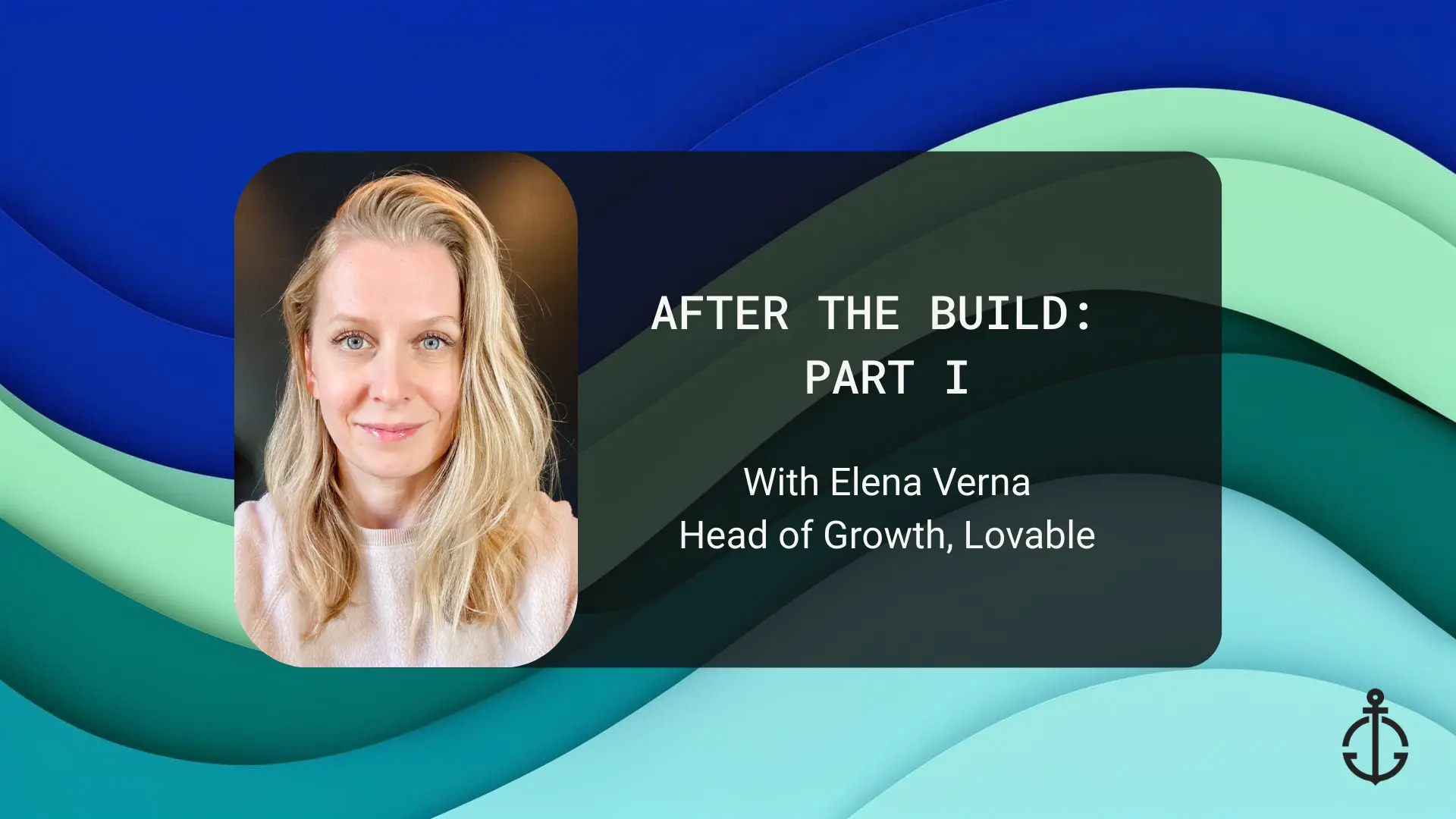
After a build, you might find yourself asking "what now?" once the ship dust settles. In this conversation, Elena Verna shares how to think about optionality as a strategy when figuring out where to place your bets and why the best next step is often the one that keeps the most doors open.

Why Generalists Are Having Their Day
AI collapsed the distance between idea and execution, but it didn't remove the need for judgment. In a market where output is cheaper, the advantage now belongs to people who can connect systems, decide under ambiguity, and integrate across functions, giving rise to the Gen Marketer.
What Operators Do After a Big Ship
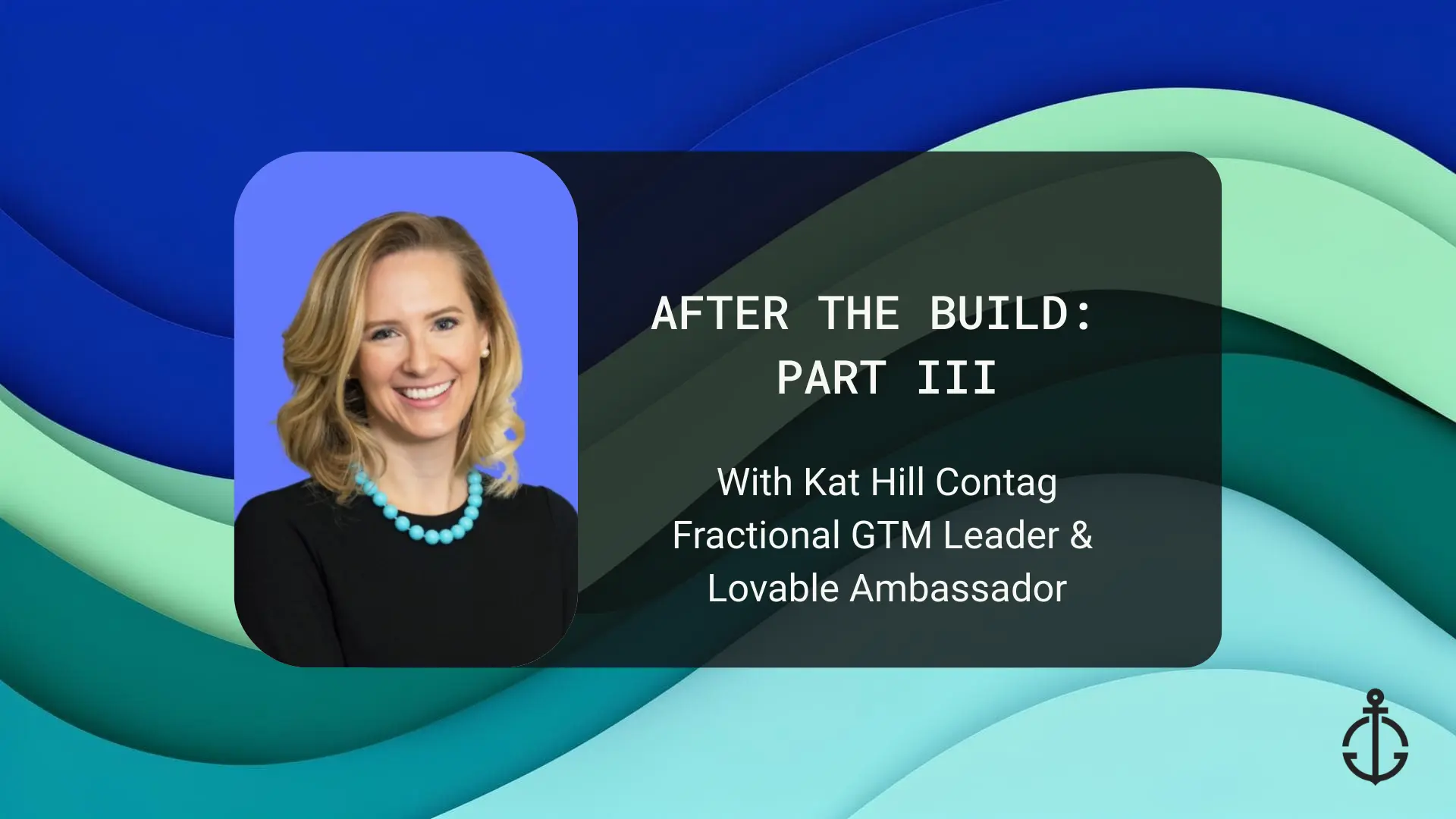
After a build, momentum creates opportunity and pressure at the same time. In this conversation, Lovable Ambassador and SheBuilds Season 01 winner Kat Hill Contag shares how operators decide what's next and turn a ship into leverage without rushing to scale.